



If you have ever ordered a number plate and seen the reference BS AU 145e, you might have moved past it without a second thought. It sounds like technical shorthand, and in some ways it is. But understanding what this standard actually covers is genuinely useful for anyone buying new plates, because it is the benchmark that determines whether your plates are road legal, MOT ready, and likely to behave exactly as they should on a daily basis. This guide breaks it down in plain terms.
BS AU 145e is the British Standard specification for retroreflecting number plates. It replaced the previous version, BS AU 145d, and sets out the precise requirements that every road legal number plate sold in the UK must meet. When a supplier tells you their plates are made to British Standard, this is the specific document they are referring to.
The standard is not just about how a plate looks. It covers materials, construction, reflectivity, character dimensions, durability, and the information that must be displayed on the plate itself. It exists to ensure that number plates are readable by humans and by the automated systems that rely on them, under all the conditions a road vehicle encounters day to day.
For a buyer, the practical value of this standard is straightforward. If your 2D printed number plate is made to BS AU 145e, you can be confident it meets every requirement for road use, will pass an MOT inspection on plate grounds, and will not cause you problems with DVLA enforcement or insurance. If it is not, you cannot have that confidence, regardless of how it looks.

The most visible element of BS AU 145e is the character specification. Every letter and number on a road legal plate must use the Charles Wright 2001 font, displayed at a precise size and with exact spacing between characters and character groups. The character height must be 79mm, the stroke width 14mm, and the margins and spacing between characters are equally tightly defined.
These dimensions are not arbitrary. They are set to ensure the registration is readable at a distance, under poor light, and by ANPR cameras travelling at speed. A plate with characters that are slightly too close together, too narrow, or rendered in a stylised font may look fine to the eye but will not perform reliably when it matters.
The standard also prohibits certain visual effects that were common on plates produced before the regulations tightened. Italic characters, 3D shadows, and decorative borders that alter character appearance are not permitted under BS AU 145e. If you are ordering 3D gel plates or 4D plates, the raised characters must still conform to the same underlying dimensions and font requirements.
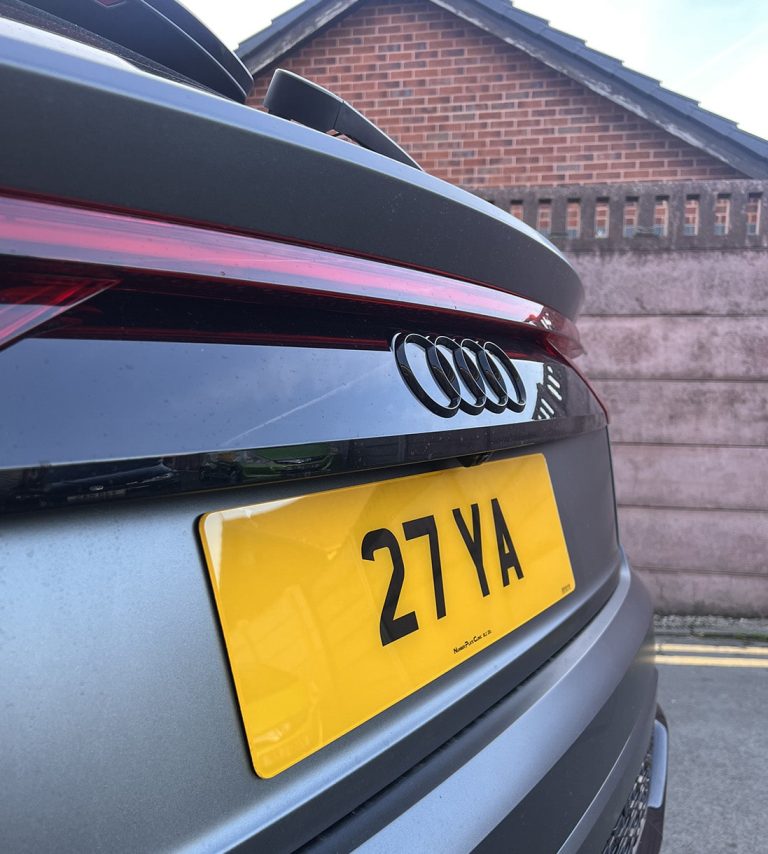
BS AU 145e sets minimum reflectivity levels for both the background material and the characters on a plate. The front plate must use a white retroreflective background and the rear a yellow retroreflective background. These are not just colour requirements. The materials must reflect light back towards its source at specified minimum levels, which is what makes plates visible at night and in low light conditions.
This is the element of the standard most likely to cause issues with budget or imported plates. Reflective material that does not meet the minimum specification will appear dull or washed out at night, reducing visibility and potentially failing a roadside check. Our article on what happens when a 2D plate is not reflective enough explains the practical consequences of this in more detail.
Smoked or tinted overlays also fall foul of this requirement. Any covering that reduces the reflective performance of the plate, even if the characters remain visible in daylight, takes the plate outside the standard and makes it not road legal.
The standard also specifies how a plate must be constructed and how it must hold up over time. Plates must be made from materials that resist UV degradation, surface cracking, and delamination under normal road conditions. A plate that fades, yellows, or loses its surface finish within a reasonable period has not been made to the required standard, regardless of how it looked when new.
This matters practically because a faded or deteriorated plate can fail an MOT just as surely as one with the wrong font. Plates made to BS AU 145e use materials that are tested to resist these issues, which is part of what you are paying for when you choose a registered supplier.
One requirement that many buyers do not think about is that every road legal plate must display the supplying company’s name or trading name, postcode, and British Standard reference on the reverse. This is a traceability requirement. It allows enforcement authorities to identify where a plate was produced if it is found to fall outside the legal standard.
If you receive a plate with no supplier information on the back, that is a clear sign it has not been produced by a registered supplier and may not meet the standard in other respects either.

Automatic Number Plate Recognition cameras are now used extensively across UK roads for enforcement, speed monitoring, insurance checks, and border control. These systems are calibrated to read plates that meet the BS AU 145e character and reflectivity specifications. A plate that deviates from these specifications may still be readable by a human officer but will produce inconsistent results when read by an ANPR camera.
With roadside plate checks becoming increasingly common and enforcement technology improving, a plate that performs poorly on ANPR is a liability even if it has not yet caused an issue. The 2025 DVLA enforcement crackdown has also increased the likelihood that substandard plates will be flagged.
A plate that does not meet BS AU 145e is not road legal. Driving with an illegal plate can, in certain circumstances, give an insurer grounds to complicate a claim. Our article on the impact of illegal plates on insurance sets out how this plays out in practice. It is a risk that is entirely avoidable by ordering from a registered supplier.
When ordering a standard 2D plate, these are the points worth confirming:
Our full range of road legal plates, from standard 2D through to 3D gel, 4D, bike plates, square plates, and specialist formats, is produced to BS AU 145e throughout. Every plate we supply carries our details on the reverse and meets the full specification for road use.
If you are ever unsure whether a specific style or format is suitable for your vehicle, get in touch with us and we will confirm before you order. And if you want to understand how these rules apply at MOT time, our guide to why number plates fail an MOT is a practical read ahead of any inspection.
Buying plates to British Standard is not just a legal formality. It is the straightforward way to make sure your vehicle is properly equipped, your insurance is not at risk, and your plates will do their job reliably for years to come.
We use cookies to improve your experience and run personalised ads. You can accept or manage your preferences.
Extra 10% OFF on Sale Product
Use Code ‘Blog10’