


If you drive a taxi or private hire vehicle in the UK, you already know that the rules governing your work go well beyond a standard driving licence. Number plate compliance is one area where professional drivers face a unique set of requirements, and understanding what applies to your vehicle is essential for staying legal and avoiding unnecessary complications. This guide breaks down the key differences between hackney carriages and private hire vehicles when it comes to number plate rules, and explains what every licensed driver needs to know.
Before getting into the specifics, it helps to understand the two main categories of licensed vehicles in the UK.
A hackney carriage, commonly referred to as a black cab or taxi, is a vehicle that can be hailed on the street or pick up passengers from a designated rank. These vehicles are licensed by the local authority in the area where they operate, and they carry plates issued by the council as a visible sign of that licensing.
A private hire vehicle, often called a minicab or PHV, cannot be hailed on the street and must be booked in advance through a licensed operator. Like hackney carriages, PHVs are licensed by the relevant local authority, but the specific requirements around identification and signage can differ.
Both categories are subject to standard DVLA number plate regulations that apply to every vehicle on UK roads. On top of that, each type carries additional licensing requirements imposed by the issuing council. Understanding both layers is essential for full compliance.
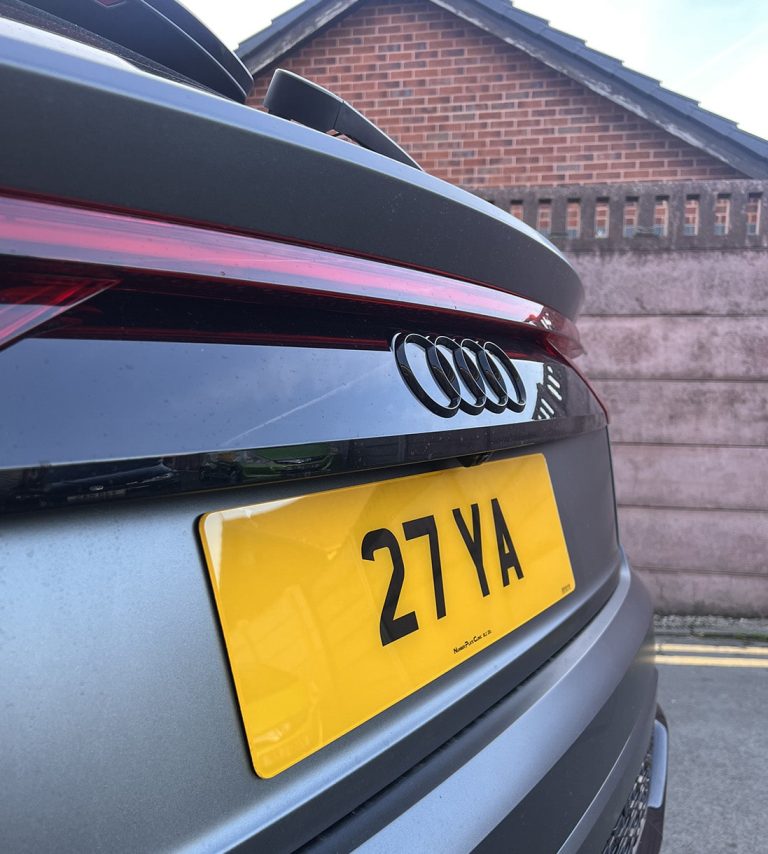
Regardless of whether your vehicle is a hackney carriage, a private hire car, or a standard private vehicle, the number plates fitted must meet current British Standard requirements. These rules cover the physical appearance and construction of the plates themselves.
All road legal number plates must:
Our guide to 4D plate legality covers how these rules apply to different plate styles, which is useful reading if you are considering an upgrade from a standard flat plate.
It is also worth noting that faded or damaged plates can create compliance issues. For professional drivers who rely on their vehicles daily, keeping plates in clean, readable condition is particularly important. Plates that are difficult to read may result in a failed vehicle inspection or attract attention from enforcement officers.
The characters on a number plate must follow precise specifications set by the DVLA. The letter height must be 79mm, the stroke width 14mm, and the spacing between characters and groups of characters must follow the required measurements exactly. These dimensions apply to all UK road legal plates, whether fitted to a family hatchback or a licensed taxi.
Any plate that deviates from these measurements, uses a font that falls outside the standard, or includes decorative elements that interfere with legibility falls outside the legal standard. Our breakdown of MOT regulations for number plates explains how these rules are assessed during a vehicle inspection, and what examiners are specifically looking for.
Beyond the standard DVLA requirements, licensed taxis and private hire vehicles in the UK must also carry identification issued directly by their licensing authority. This is where the rules become more specific to the transport industry.
Hackney carriages are typically required to display plates issued by the council, sometimes called taxi plates or licence plates, that are separate from the DVLA registered number plates. These are usually fixed to the exterior of the vehicle, often at the rear, and identify the vehicle as being licensed to operate in a specific council area. The format and positioning of these plates vary between councils, so it is important to follow the instructions given by your local licensing authority.
Private hire vehicles are generally required to display a licensing disc or plate provided by the council. This is usually a circular or rectangular disc displayed in the windscreen, confirming the vehicle is licensed for private hire use. Again, the specific requirements differ from one local authority to another, and some councils also require exterior identifying plates on PHVs.
As a general rule, both vehicle types must ensure the following are always in order:
These identifiers issued by the council are separate from the registered number plate and do not replace it. Your DVLA registered plates must remain visible, correctly positioned, and fully compliant regardless of what additional licensing identification is required.
One of the most important things to understand about taxi and PHV licensing in the UK is that it is administered locally, not nationally. The licensing regime is governed by the Local Government (Miscellaneous Provisions) Act 1976 for most of England and Wales, with different legislation applying in London and Scotland. Because licensing decisions rest with individual councils, the specific requirements around vehicle identification, signage, and plate positioning can differ significantly between areas.
This means a vehicle that is fully compliant in one council area may need adjustments to meet the requirements of another. If you operate across council boundaries, or if you are applying for a licence in a new area, always check the specific requirements of the relevant licensing authority before having any plates or signage fitted.
The GOV.UK guidance on taxi and private hire licensing provides a useful overview of best practice guidance for licensing authorities, though the detail of individual requirements will always be found at council level. For London, the Transport for London licensing pages cover the specific requirements for the capital in detail.
For professional drivers, the stakes around number plate compliance are higher than for most private motorists. Your vehicle is your livelihood, and any issue with plates or identification can affect your ability to operate, pass vehicle inspections, and maintain your licence.
It is worth knowing that driving without a correctly displayed front number plate is an offence that applies to all vehicles, including licensed taxis and PHVs. Similarly, plates that fail to meet the required standard can result in a failed MOT, as our guide to why number plates fail an MOT explains in detail.
There is also an insurance dimension to consider. Plates that do not meet the required standard can give insurers grounds to complicate a claim, particularly if the plate modification contributed to an incident or obscured the vehicle’s identification. For licensed drivers, where commercial insurance is essential, it is sensible to ensure your plates are always above reproach. Our article on the impact of illegal plates on insurance covers this in more detail.
With roadside plate checks becoming increasingly common and the 2025 DVLA enforcement crackdown increasing scrutiny on modified and non-standard plates, there has never been a better time to make sure your vehicle is fully compliant.
If you are in the market for replacement plates, our range of standard 2D printed number plates and 3D gel number plates are all made to current British Standard regulations and are suitable for road legal use. Every plate we supply is built to meet DVLA requirements, so you can order with confidence.
Understanding the rules around taxi and private hire number plates does not need to be complicated. The key is knowing the two layers of compliance: the standard DVLA requirements that apply to every vehicle on UK roads, and the additional identification requirements set by your local licensing authority.
If you are unsure whether your current plates meet the required standard, or if you need to order new plates ahead of a vehicle inspection or licence renewal, we are here to help. Get in touch with us and our team will point you in the right direction.
We use cookies to improve your experience and run personalised ads. You can accept or manage your preferences.
Extra 10% OFF on Sale Product
Use Code ‘Blog10’