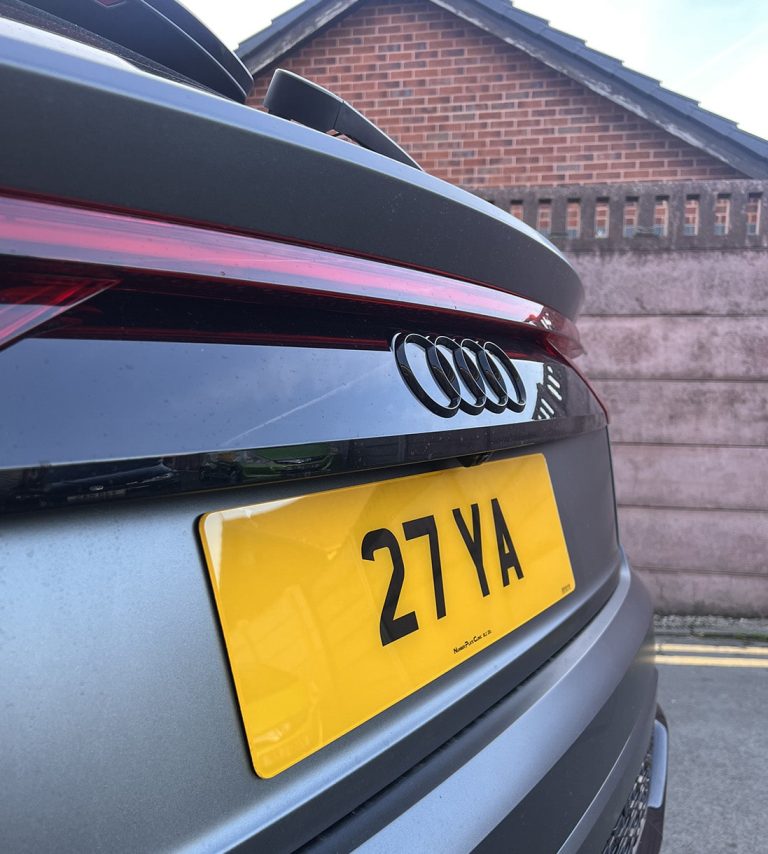

Carbon fibre number plates have become increasingly popular with UK drivers looking for a sleek, premium finish. The textured, woven aesthetic appeals to modified car owners, track day enthusiasts, and anyone wanting their vehicle to stand out from the standard.
Before you commit to this style, the most important question is whether carbon fibre plates are actually road legal in the UK.
The answer depends on how they are made and whether they meet DVLA requirements. Many carbon fibre style plates on the market fall outside the regulations for road use. This guide explains exactly where the compliance boundaries lie, what your alternatives are, and how to get the look you want without the complications.
Carbon fibre number plates feature a dark, patterned background designed to replicate the look of real carbon fibre. Some achieve this using vinyl overlays, printed textures, or tinted acrylic panels. The result is a darker, textured surface that sits at the opposite end of the spectrum from the standard white and yellow reflective plates most drivers are familiar with.
They tend to appeal to:
Appearance alone does not determine legality. Compliance with UK number plate regulations does, and the two do not always align.

Number plates used on UK roads must meet the requirements set out by the DVLA under the Road Vehicles (Display of Registration Marks) Regulations 2001. The physical and material standards are defined in British Standard BS AU 145e. Together, these documents cover everything from background colour to font, character spacing, and registered supplier identification.
For most vehicles first registered after 1 January 1980, the core requirements are:
Any design that alters reflectivity, changes the required background colour, or affects character legibility falls outside these requirements. Our guide to number plate regulations explains each requirement in detail for drivers who want a full picture before they buy.
Whether a carbon fibre plate is road legal comes down to one question: does the background retain the required white or yellow reflective surface?
Most carbon fibre plates use a dark, woven, or textured background that either replaces or significantly reduces that reflective base. When the background does not meet the white front or yellow rear requirement, the plate does not comply with UK regulations, regardless of how the characters are produced or how the rest of the specification is met.
A small number of manufacturers produce plates where a subtle carbon effect is achieved within a fully compliant reflective base. These exist, but they are uncommon, and they must still pass British Standard testing to qualify as road legal. If you are considering a specific product and want to confirm whether it meets the standard before purchasing, get in touch with our team and we can help you assess it.
A carbon fibre style plate is not road legal if it:
If a plate meets any of these descriptions, it cannot be legally displayed on a vehicle used on public roads in the UK.
Many carbon fibre-style plates are sold as show plates, meaning they are designed for display or off-road use only. This is a legitimate product category when used correctly. Our show plate range covers a variety of styles and formats for drivers who want that look in the right context.
Show plates are well suited to:
They are not suitable for public road use. Fitting a show plate to a vehicle driven on the road means the vehicle is not displaying a compliant registration mark, and that creates practical problems at MOT time and during everyday use.
Understanding this distinction before you buy makes it straightforward to choose the right product for the right purpose.
For drivers who want a premium, modern finish that stays within the law, there are several fully compliant options available. Each offers a step up from a standard flat plate without compromising the DVLA requirements that matter for road use.
3D gel plates add a raised, domed resin coating over each character, creating depth and definition that makes the registration stand out. The reflective background is retained in full, the character colours remain correct, and the plate meets British Standard requirements throughout. Our 3D gel plates are one of the most popular choices for drivers who want a premium finish without any compliance trade-off.
4D plates use precision cut acrylic characters bonded to the plate surface. The defined edges and sharper raised profile give the plate a bold, contemporary look. When produced to the correct specification, including the right font, dimensions, and reflective background, 4D plates are fully road legal. Our 4D plate range is clearly split between road legal and display use options so you know exactly what you are ordering.
Traditional reflective printed plates are the straightforward, reliable choice. They meet all British Standard requirements, are produced on approved reflective substrates, and carry all the required supplier markings as standard. No complications, DVLA approved materials, and fully road legal from the outset.
For vehicles that need an alternative layout, formats such as square plates and hex style plates are available. Shape alone does not affect legality. The same reflectivity, font, and spacing requirements apply across all formats, regardless of how the plate is shaped.
Plates that do not comply have three main practical implications that are worth understanding before you choose a style.
During an MOT, number plates are checked for compliance. A plate that does not meet the required standard can contribute to a failure, requiring replacement before the vehicle is signed off. In everyday driving, a police officer can require a driver to address a plate that does not meet reflectivity, legibility, or spacing requirements, and failure to rectify the issue can lead to further action. When it comes to insurance, fitting plates that have not been declared can raise questions with your insurer in the event of a claim.
In each of these situations the practical outcome is the same: the plates need to be replaced. Ordering from a registered supplier and confirming the product is road legal before it arrives avoids that inconvenience entirely.
Some drivers consider applying a carbon fibre vinyl overlay to an existing plate to achieve the effect without buying new. Modifying a plate after it has been produced and marked by a registered supplier, however, invalidates its compliance. The plate can only be considered road legal in the state in which it was manufactured and issued.
Producing your own plates for road use is also a regulated activity. Unless you are registered as a number plate supplier and operate within the associated requirements, you cannot legally manufacture plates for use on public roads. This applies to any modification, not just carbon fibre overlays.

Before fitting any carbon fibre style plate to a vehicle, working through these points gives you a clear picture of whether it qualifies for road use:
If any of these conditions are not met, the plate does not qualify for road use in the UK.
Most carbon fibre number plates do not meet UK road legal requirements. The dark patterned background conflicts with the reflectivity standard, and if the white or yellow reflective base is altered or replaced, the plate is not road legal regardless of how the characters are produced.
For drivers who want a distinctive finish that is fully DVLA approved, 3D gel and 4D plates from a registered supplier are the practical choice. At Number Plate Clinic, every plate is produced to BS AU 145e and we carry full DVLA registration as a supplier.
Browse our full road-legal plate range or get in touch with our team if you have a question about a specific style before you order.